
Windows 11 finally beats Windows 10 in gaming performance
Before the release of the Windows 11 25H2 update, Microsoft claimed that this major new update would improve gaming performance, one of the aspects that has always been criticized in this version compared to Windows 10. Although an additional year of free support has been added for all users who use a Microsoft account, sooner or later Windows 10 will stop being a secure option as an operating system

The team at Hardware Unboxed carried out a performance comparison last year using the versions of Windows 10 and Windows 11 available at the time, a test that ended with Microsoft’s 2015 operating system, Windows 10, coming out on top.
This YouTube channel wanted to see firsthand whether the improvements Microsoft has introduced with the release of the Windows 11 25H2 update actually make a real difference. The result, as we already hinted at in the headline, shows that Windows 11 is, for the first time, the best option for gaming today, as long as we are not considering SteamOS, Bazzite, or similar alternatives.
Windows 11 offers an average performance advantage of 4–5% compared to Windows 10
To carry out this test, as expected, an AMD Ryzen 7 9800X3D processor was used alongside an NVIDIA RTX 5090. In both cases, VBS and system virtualization were disabled through the BIOS. To confirm the results obtained with the main test system, performance was also analyzed using an AMD Ryzen 7 9700X processor paired with an AMD RX 9070 XT graphics card.
The titles tested with both configurations, using Windows 10 22H2 and Windows 11 25H2, were Rainbow Six Siege X, Battlefield 6, ARC Raiders, Borderlands 4, Marvel Rivals, Baldur’s Gate 3 running in DX11 mode, Cyberpunk 2077: Phantom Liberty, Counter-Strike 2, Space Marine 2, Mafia: The Old Country, Assetto Corsa Competizione, Spider-Man 2, Horizon Zero Dawn Remastered, The Last of Us Part II Remastered, and Ratchet & Clank: Rift Apart.
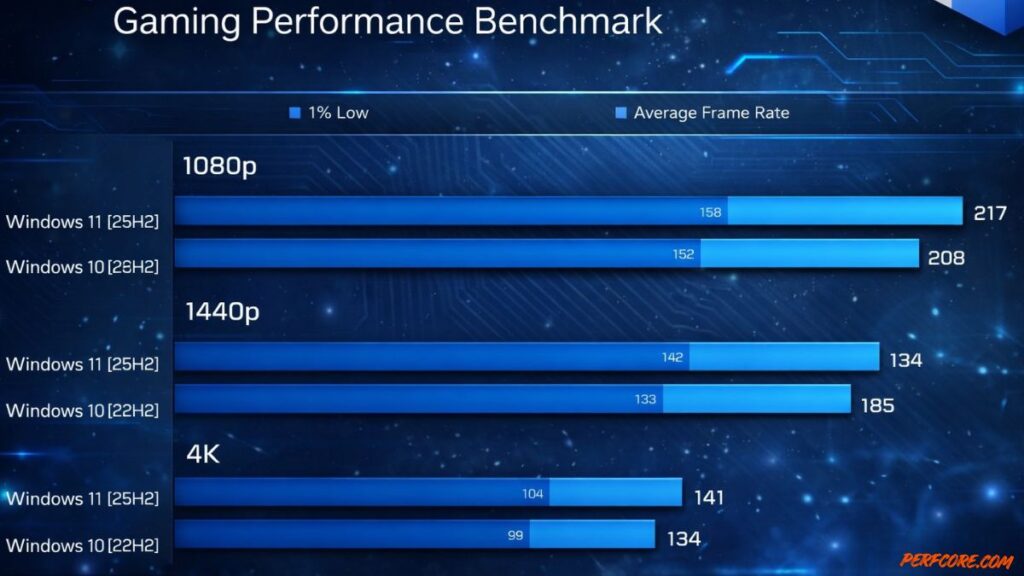
Performance in competitive games such as Battlefield 6, Counter-Strike 2, and Assetto Corsa Competizione is practically the same when using the same hardware configuration, whether running Windows 11 25H2 or Windows 10 22H2. The title that shows a clear performance advantage on Windows 11 is ARC Raiders, which delivers between 11% and 15% more FPS across all resolutions.
Borderlands 4 delivers 13% more FPS at 1080p and 1440p, with the improvement dropping to 9% at 4K. The remastered versions of both Spider-Man 2 and Horizon Zero Dawn deliver between 7% and 10% more FPS at 1080p and 1440p, with virtually the same improvement also seen at 4K resolution.
In the case of The Last of Us Part II, we can see that at 1080p Windows 10 delivers a higher FPS count, while Windows 11 takes the lead at 4K resolution, which, according to the testers, could be due to an NVIDIA driver issue.
In tests using the Ryzen 7 9700X together with AMD’s RX 9070 XT, performance differences are practically nonexistent, which suggests that the improvement comes from NVIDIA’s drivers, which appear to be better optimized for Windows 11 than AMD’s drivers.
Beyond raw FPS benchmarks, it is true that Microsoft has been working for months on deep optimizations in Windows 11 aimed at gaming, including the Performance Fundamentals initiative, designed to improve system resource management and the game execution experience through adjustments to the operating system kernel scheduler, better handling of background workloads, and improvements to shader compilation.
In summary, after analyzing the 14 titles mentioned above, Windows 11 performance at 1080p is 4% higher than what Windows 10 delivers. At 4K resolution, the performance difference in favor of Windows 11 averages around 5%.
The biggest gains are seen in triple-A titles, where Windows 11 outperforms the previous version while maintaining similar performance in competitive games.

Sara Jakob is the Senior Gaming Software & Systems Editor at PerfCore, specializing in PC game optimization, browser performance benchmarks, and free-to-play MMO mechanics. With a background in computer science and software testing, Sara leads PerfCore’s game setting optimization guides and software utility reviews.